
Creation of the coat of arms and the flag
Considering that Cartajima had no prior record of using a coat of arms or a heraldic flag, it was necessary to create one.
On February 7, 2001, the Cartajima Town Hall requested a report for the adoption of a coat of arms and a flag. After a study carried out by BORBONE, the Institute of Municipal Heraldry and Vexillology, and the Spanish Society of Heraldry and Vexillology, the Town Hall was advised to begin the corresponding procedure.
The Coat of Arms
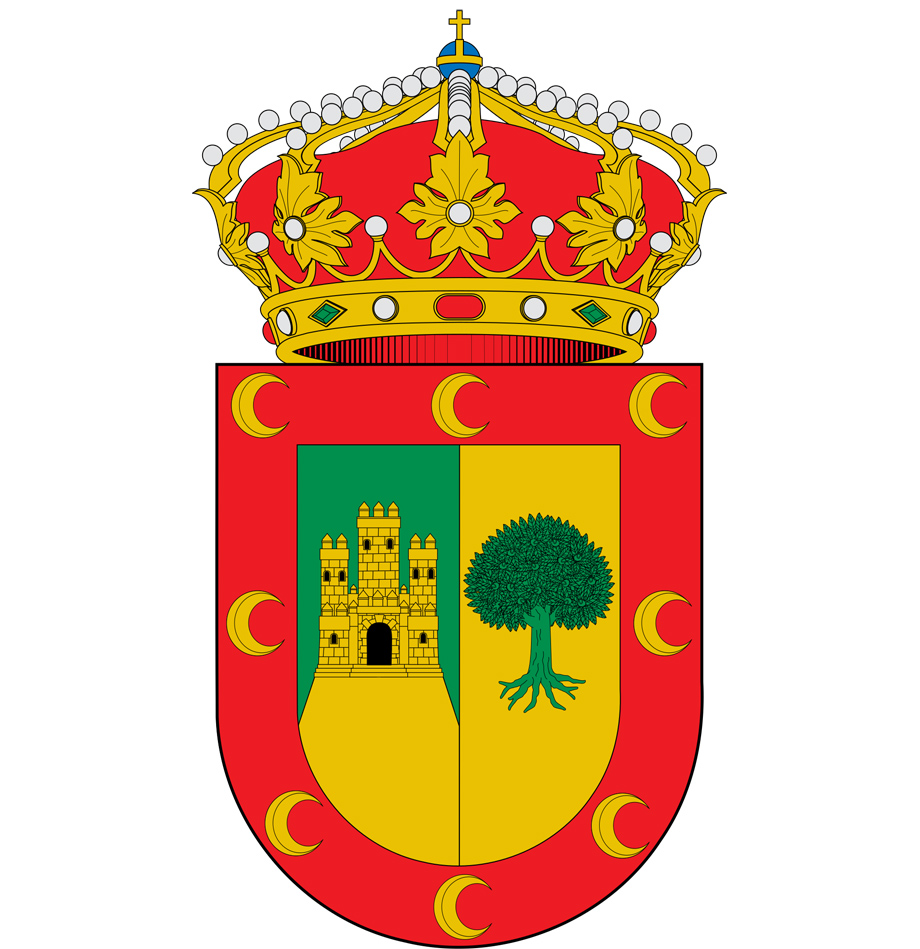
Cartajima’s coat of arms was created with the intention of reflecting, with its own identity, the most representative elements of its history, its landscape, and its past. Following the criteria established by heraldry specialists, the choice of its symbols responds to a careful balance between tradition and meaning.
Unlike other municipalities, Cartajima does not have ancient noble lineages or distinctive historical symbols. Therefore, its coat of arms is inspired by three elements deeply connected to the village:
The castle
Now in ruins atop Mount Romeral, a testament to its defensive importance in past times.
The crescent
An evocation of its Islamic past.
The chestnut tree
An emblematic tree of Cartajima’s natural surroundings and a foundation of its local economy.
The heraldic design reflects these elements with a harmonious and symbolic approach: a divided shield, with a golden castle on a green hill on one side, and a chestnut tree on the other, all framed by a red border with eight golden crescents. The whole is topped with the traditional royal crown.
This coat of arms not only represents the history of Cartajima, but also its landscape, cultural identity, and connection to the land.
The Flag
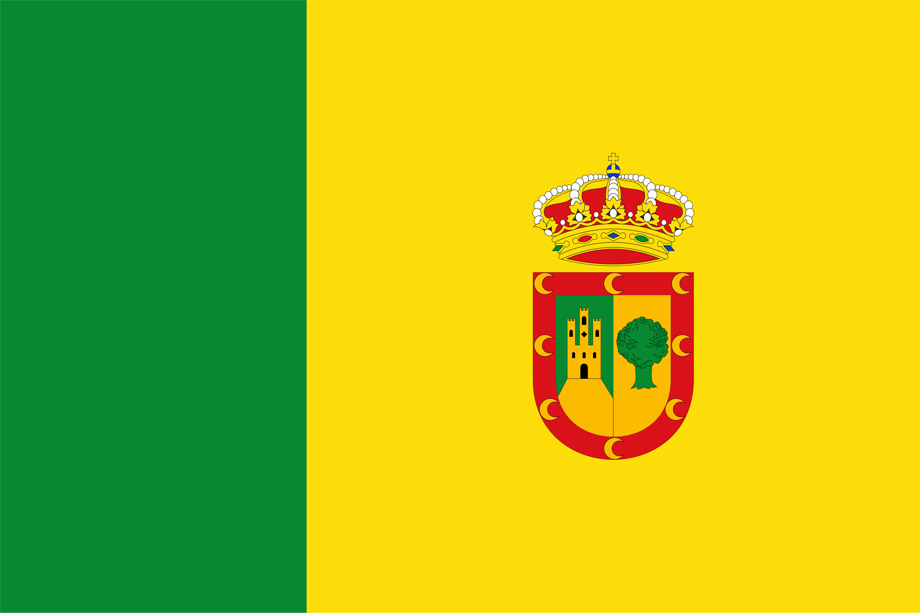
The flag of Cartajima is a symbol of identity that incorporates the colors and representative elements of the municipality, keeping the coat of arms as its central feature, shared and recognized by all its inhabitants.
Its design is simple yet meaningful: a rectangular cloth with a 2:3 ratio, divided vertically into two stripes. The stripe closest to the hoist is green and occupies one third of the total; the remaining, wider section is yellow. At the center of the latter is the municipal coat of arms, topped with the royal crown.
This flag combines the chromatic harmony of the coat of arms with a clean and representative design, proudly waving as the official symbol of the municipality.